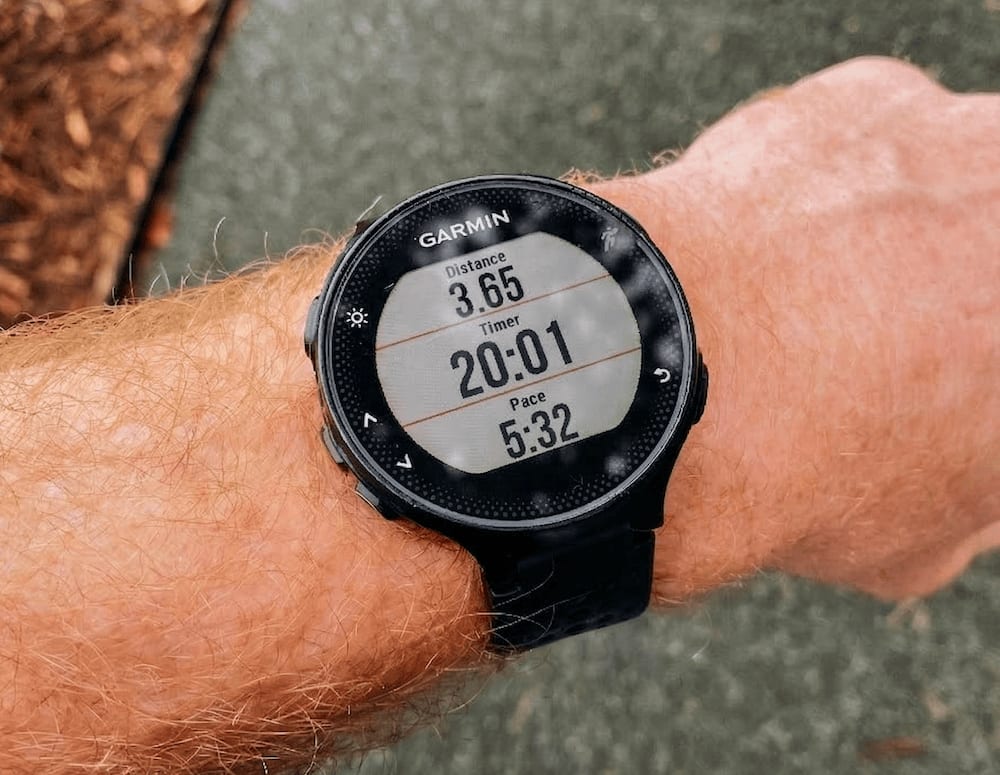
You find a training plan you like, but every session is written in min/mile and your watch, your local parkrun and your head all run in min/km. Or a treadmill only speaks km/h while your goal pace lives in minutes per kilometre. Pace conversion is the small skill that stops these mismatches from derailing a session. Get comfortable moving between min/km, min/mile, km/h and mph and any plan, any race, any treadmill becomes readable at a glance.

This guide gives you the four conversions runners actually need, the simple arithmetic behind each one, a quick reference table, and the one trap that makes most manual conversions wrong. None of it needs more than the times already on your watch.
What pace conversion actually involves
Two different ideas hide inside a single number. Pace is time per distance, written as minutes per kilometre or minutes per mile, and lower is faster. Speed is distance per time, written as kilometres per hour or miles per hour, and higher is faster. That inversion is the whole reason conversion trips people up: to turn pace into speed you divide, not multiply, so a quicker pace produces a bigger speed number moving in the opposite direction.
The distance units rest on one fixed fact. One mile equals exactly 1.609344 kilometres, set by the international yard and pound agreement of 1959 and still the definition every governing body uses. World Athletics builds its standard track and road distances in metres from the same base. Every conversion below is just that ratio, 1.609344, applied in the right direction.
How to convert min/km to min/mile and km/h
Four conversions cover almost everything you will meet. Work in decimal minutes for the arithmetic, then turn the decimal back into seconds at the end (0.5 min is 30 seconds, 0.25 min is 15 seconds).
- min/km to min/mile: multiply by 1.609. A mile is longer than a kilometre, so each mile takes more time. 5:00 min/km becomes 5.0 x 1.609 = 8.05, or about 8:03 min/mile.
- min/mile to min/km: divide by 1.609. 8:00 min/mile becomes 8.0 / 1.609 = 4.97, or about 4:58 min/km.
- min/km to km/h: divide 60 by your pace in decimal minutes. 5:00 min/km becomes 60 / 5.0 = 12 km/h. The same formula runs backwards: 60 / speed gives pace, so 10 km/h is 60 / 10 = 6:00 min/km.
- km/h to mph: divide by 1.609. 12 km/h becomes 7.46 mph. To read a treadmill in mph as pace, convert to km/h first, then to min/km.
The trap sits in step one and two: 5:00 min/km is five and zero, not five and a half. If you type it as 5.5 you have just added 30 seconds to every kilometre. Convert the minutes and seconds to a decimal before you multiply, or let a pace calculator hold the decimals for you so a mental slip never reaches your splits. Once the target pace is set, a split time calculator turns it into the per-kilometre or per-mile checkpoints you actually race off.
Pace conversions runners reach for most
Some conversions come up every week. A runner following a US marathon plan at 8:00 min/mile is really training at 4:58 min/km, close enough to round to 5:00 for daily use. A parkrunner chasing a sub-25:00 5 km needs 5:00 min/km, which a treadmill will show as 12 km/h. A track session at 4:00 min/km is 15 km/h and 6:26 min/mile. Keep this table nearby until the common ones stick.
- 4:00 min/km = 6:26 min/mile = 15.0 km/h = 9.3 mph
- 5:00 min/km = 8:03 min/mile = 12.0 km/h = 7.5 mph
- 6:00 min/km = 9:39 min/mile = 10.0 km/h = 6.2 mph
- 7:00 min/km = 11:16 min/mile = 8.6 km/h = 5.3 mph
Conversion tells you what a pace equals on flat ground, but not what it costs you on a hill. When the route climbs, the honest comparison is grade adjusted pace, not the raw number. And once your target pace is locked in whichever unit you think in, using a pace calculator to plan a smarter race turns it into a strategy rather than a guess.
When pace conversion earns its keep
The skill pays off in a handful of recurring situations, and spotting them early saves a ruined session. Treadmills are the obvious one: most display km/h or mph, so a plan written in min/km needs converting before you touch the speed dial, and a slip of one decimal means running a completely different workout. Imported training plans are the next. US plans almost always run in min/mile, UK and European plans in min/km, and following one in the wrong unit quietly shifts every easy run and every interval off target.
Races catch people out too. Enter an event abroad and the course markers, the pace groups and the finish predictions may all be in the unit you do not train in, so knowing your goal pace in both keeps you calm on the start line. The same goes for comparing notes with a training partner in another country: convert once, agree on a shared unit, and the numbers stop being an argument. In every case the maths is the four conversions above, applied the moment a mismatch appears rather than mid-run when your brain has other jobs.
Pace conversion questions runners ask
How do I convert km/h to min/km?
Divide 60 by the speed in km/h. At 10 km/h your pace is 60 / 10 = 6:00 min/km; at 12 km/h it is 60 / 12 = 5:00 min/km. The relationship is symmetric, so the same sum converts the other way: 60 divided by your pace in decimal minutes returns the speed. This is the conversion treadmill runners need most, since the belt shows km/h while the plan is written in min/km.
Is a pace converter more accurate than doing it by hand?
The arithmetic is identical; the difference is how easy it is to slip. A pace converter keeps the minutes-and-seconds to decimal step exact, which is where hand conversions usually go wrong. For a single round number the mental method is fine. For a full set of race splits, or when you are tired at the end of a long run, let the tool carry the decimals.
Why do my watch and a pace converter disagree slightly?
Rounding, almost always. Watches round pace to the nearest second and distance to the nearest few metres, and GPS drift nudges both. A converter works from exact figures. A gap of one or two seconds per kilometre between the two is normal and nothing to chase.
Should I convert pace or speed?
Convert whichever your source uses, but think in pace for running. Pace maps directly onto a race: 5:00 min/km immediately tells you a 5 km takes 25:00. Speed in km/h is handy for treadmills and cycling crossover, but for pacing a run, minutes per kilometre or per mile is the number that plans itself.
Recommended running gear
Whether you are just getting started or looking to upgrade, these are solid choices that suit most runners.
Garmin Forerunner 265
The best mid-range GPS watch for runners. AMOLED display, accurate pace tracking, and training load insights.
View on AmazonNike Pegasus
A versatile daily trainer suitable for easy runs, tempo sessions, and race day. One of the most popular running shoes.
View on AmazonFoam Roller
Helps with recovery after runs. A simple, affordable tool that reduces muscle soreness and tightness.
View on Amazon
I'm Doing My Best Running Jersey
Lightweight, breathable unisex sports jersey in neon yellow. Designed for runners who keep showing up.
Free worldwide shipping on select orders
RunReps works with retail partners through the Awin affiliate network and earns a commission on qualifying purchases at no extra cost to you.