You finish a run, glance at your watch, and the first number you look for is pace. 5:32 min/km. Faster than last week. Good session. But here is a question worth sitting with: do you actually know what that number means – and, more importantly, what it leaves out?

Your running pace is one of the most useful metrics you have. It can reveal fitness trends, flag overtraining, and anchor your race-day plan. Turning that race-day plan into concrete first- and second-half targets is covered in how to calculate a negative split. But treated as the only number that matters, it can also mislead you. This article breaks down exactly what pace tells you, where it falls short, and how to read your numbers with the clarity of a coach, not the anxiety of a stopwatch.
What Your Pace Per Kilometre Actually Reveals
Pace – measured in minutes per kilometre or minutes per mile – is a snapshot of speed over distance. That is all it is, mathematically. But over time, it becomes something more useful: a record of your fitness trajectory. That record only holds up if you compare like with like, so when your watch reads min/km and your plan is written in min/mile, put both into the same unit before you draw any conclusions.
When you run the same route at the same effort and your pace drops from 5:45 min/km to 5:30 min/km over six weeks, that is real, measurable progress. No lab test required. Dr. Jack Daniels, the exercise physiologist behind Daniels’ Running Formula, built his entire VDOT system on the principle that race pace is a reliable proxy for aerobic capacity (Daniels, 2014). Your pace at a given effort level correlates closely with your VO2max – and tracking it over time tells you whether your training is working.
Pace also gives you a planning tool. Plug a recent 5 km or 10 km result into the RunReps Pace Calculator and you get a clear baseline: the speed you have proven you can hold. From there, you can set realistic targets for longer distances, structure interval sessions, and build a race plan grounded in data rather than hope.
Coach’s insight: Your pace on a flat, windless, cool morning is your true benchmark. Any other conditions – heat, hills, fatigue – will shift the number. Compare like with like, or you will chase ghosts.
Where Pace Stops Telling the Truth

Here is where runners get into trouble. Pace is a measure of output, not effort. Two runs can produce the same 5:30 min/km split and feel completely different – because the conditions were different, your body was different, or both. Weight is one of the quieter variables in that list, and how much of your pace is explained by body weight puts a figure on how much of the gap it accounts for.
Heat and humidity. Research published in Medicine and Science in Sports and Exercise shows that for every 5 degrees Celsius above 15, running performance drops by roughly 1-2% (Ely et al., 2007). A 5:30 min/km run in 25-degree heat demands significantly more cardiovascular work than the same pace at 12 degrees. Your watch does not know this. You need to.
Terrain and elevation. Running 5:30 min/km uphill is a fundamentally harder effort than running 5:30 min/km on flat ground. If you train on hilly routes and compare your splits to flat-course benchmarks, you will consistently underestimate your fitness. The effort was there – the pace just could not show it. Body weight works on the number the same way, and how body weight changes your pace puts a figure on it.
Fatigue and recovery state. Imagine this: you ran a hard interval session yesterday. Today, your easy run comes in at 6:15 min/km instead of your usual 5:50. Your watch says you were slower. Your body says you were recovering. Both are true – but only one matters for your long-term progress. Chasing pace on fatigued legs is how overtraining starts.
Wind. A 20 km/h headwind can add 15-30 seconds per kilometre to your pace without any change in your effort. A tailwind on the return does not fully cancel it out either – the aerodynamic penalty of running into wind is greater than the benefit of wind at your back. Reading a 20 km/h headwind against a min/km target means holding two units at once, which is exactly what pace conversion makes routine.
How to Read Your Pace Like a Coach
The shift from obsessing over pace to understanding pace is straightforward. It requires one habit: pairing your pace data with context.
Step 1: Record the conditions. After every run, note the temperature, terrain, wind, and how you felt. Most running apps let you add notes. Use them. A pace of 5:40 min/km on a hilly route in 28-degree heat tells a very different story from 5:40 min/km on a flat path in autumn.
Step 2: Track effort, not just speed. Heart rate is the simplest effort metric available to most runners. If your pace stays at 5:30 min/km but your heart rate drops from 165 bpm to 155 bpm over a month, you are fitter – even though the stopwatch shows the same number. Use the RunReps Pace to Heart Rate Zone Calculator to see which training zone your current pace falls into. That context turns a flat number into actionable insight.
Step 3: Compare over weeks, not days. A single run is noise. A four-week trend is signal. Look at your average easy-run pace across a training block, not the splits from Tuesday versus Thursday. Fitness does not move in straight lines – it zigzags. Zoom out.
Step 4: Separate your run types. Your easy pace, tempo pace, interval pace, and race pace are different tools for different jobs. Comparing them to each other is like comparing a warm-up jog to a sprint finish. Track each one independently and you will see where real gains are happening.
When Pace Matters Most – And When to Ignore It

There are moments when pace is the right number to watch and moments when it actively gets in the way.
Trust pace when:
- You are setting race-day targets on a flat, measured course – see how this works in practice with the Tokyo Marathon 2026 course guide and pace targets
- You are running intervals on a track or flat loop with controlled conditions
- You are comparing the same route, same conditions, over multiple weeks
- You are using a pace calculator to build a split strategy for a goal race
Ignore pace when:
- You are running on trails, hills, or uneven terrain
- You are in the first three days after a hard race or workout
- The temperature is above 25 degrees or below freezing
- You are running easy and the goal is recovery, not speed
The runners who improve year after year are not the ones who chase every split. They are the ones who know which splits to chase and which to let go.
The Metrics That Fill the Gaps Pace Leaves Behind
If pace is the headline, these are the paragraphs that give it meaning.
Heart rate. Shows how hard your body is working regardless of external conditions. A rising heart rate at the same pace signals fatigue or heat stress. A falling heart rate at the same pace signals improved fitness.
Rate of perceived exertion (RPE). A 1-10 scale based on how hard the effort feels. Simple, free, and surprisingly reliable. Research from the Medicine & Science in Sports & Exercise shows that RPE correlates well with physiological markers of intensity in trained runners (Borg, 1982). If your pace says easy but your RPE says hard, trust your body.
Cadence. The number of steps you take per minute. It does not directly measure fitness, but changes in cadence at the same pace can indicate fatigue or form breakdown – both useful signals during long runs and races.
Pace drift. How much your pace changes across a run at steady effort. If you set out at 5:30 min/km and finish at 5:50 min/km without increasing effort, that drift tells you something about your endurance, fuelling, or the conditions – not about whether you had a “bad” run.
Pace Questions Every Runner Should Be Able to Answer

Does a faster pace always mean better fitness?
No. A faster pace on a given day might reflect cooler weather, a tailwind, a flat route, or simply being well rested. True fitness gains show up as faster paces at the same or lower effort over multiple weeks – not as a one-off good session. Compare your pace alongside heart rate or RPE to see the full picture.
Why is my running pace slower on some days even when I feel fine?
Dozens of factors affect pace beyond fitness: sleep quality, hydration, time of day, what you ate, residual fatigue from previous sessions, and environmental conditions. A “slow” day at the right effort level is still a productive training day. Do not let pace alone dictate whether a run was successful.
Should I use pace or heart rate to guide my training?
Both. Pace is best for structured sessions where you need to hit specific targets – intervals, tempo runs, race-day splits. Heart rate is best for easy and recovery runs where the goal is staying in the right effort zone regardless of speed. Using one without the other gives you an incomplete picture of your training load.
How often should I test my pace to track progress?
Every four to six weeks is enough. Run a time trial over a set distance – a parkrun 5 km works well – and compare your result to previous efforts under similar conditions. More frequent testing adds stress without adding useful data. Let your training do the work between tests.
This article is for informational purposes only. Always consult a qualified coach or medical professional before making significant changes to your training programme.
Race day essentials
Having the right kit on race day removes one more variable. These items help you execute your race plan with confidence.
Garmin Forerunner 265
Live pace alerts and lap tracking keep you honest on race day. The AMOLED display is easy to read mid-race.
View on AmazonSiS Go Energy Gels
Isotonic gels that go down easily during a race. No need to find a water station to wash them down.
View on AmazonRunning Belt
Carry gels, phone, and keys without bouncing. A simple belt keeps everything secure so you can focus on your pace.
View on Amazon
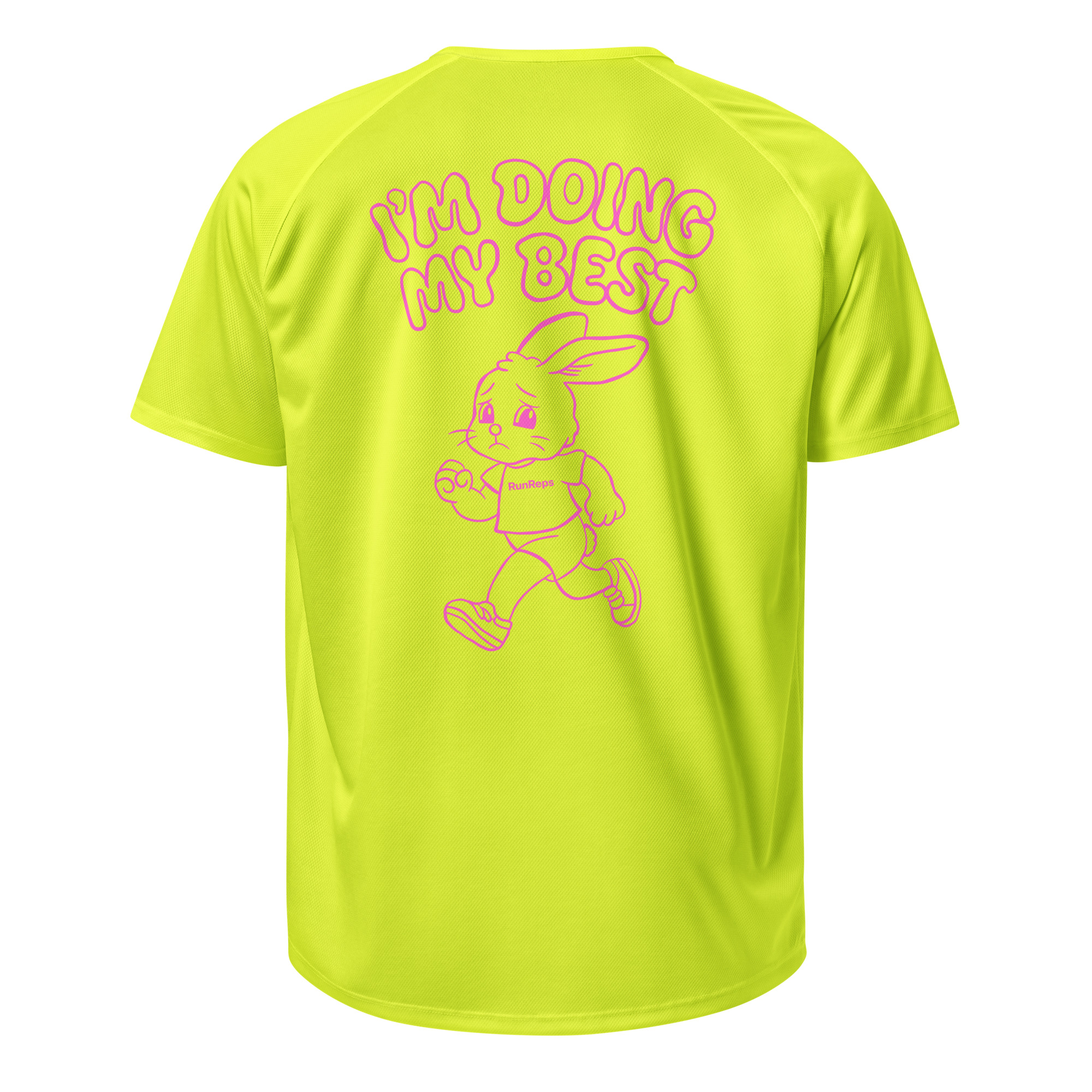
I'm Doing My Best Running Jersey
Lightweight, breathable unisex sports jersey in neon yellow. Designed for runners who keep showing up.
Free worldwide shipping on select orders
RunReps works with retail partners through the Awin affiliate network and earns a commission on qualifying purchases at no extra cost to you.