Pace Converter
Switch a pace between min/km, min/mile, km/h and mph in real time. Enter any one value and every other unit updates as you type.
Quick presets
Common pace conversions
| min/km | min/mile | km/h | |
|---|---|---|---|
| 3:30 | 5:38 | 17.1 | 10.7 |
| 4:00 | 6:26 | 15.0 | 9.3 |
| 4:30 | 7:15 | 13.3 | 8.3 |
| 5:00 | 8:03 | 12.0 | 7.5 |
| 5:30 | 8:51 | 10.9 | 6.8 |
| 6:00 | 9:39 | 10.0 | 6.2 |
| 6:30 | 10:28 | 9.2 | 5.7 |
| 7:00 | 11:16 | 8.6 | 5.3 |
| 8:00 | 12:52 | 7.5 | 4.7 |
| 10:00 | 16:06 | 6.0 | 3.7 |
Click any row to load that pace.
GPS watches for tracking your pace
Knowing your pace numbers is only half the job - a GPS watch tells you your pace live, every run. These are our top picks.
Garmin Forerunner 265
AMOLED display, live pace alerts, and advanced training analytics. The best mid-range option for runners focused on pace.
View on AmazonGarmin Forerunner 255
Accurate GPS, up to 14 days battery, and reliable pace tracking. A solid first serious running watch at a fair price.
View on AmazonASICS Gel-Nimbus 26
High-cushion neutral trainer built for long miles and easy days. One of the most popular everyday trainers for distance runners.
View on Amazon
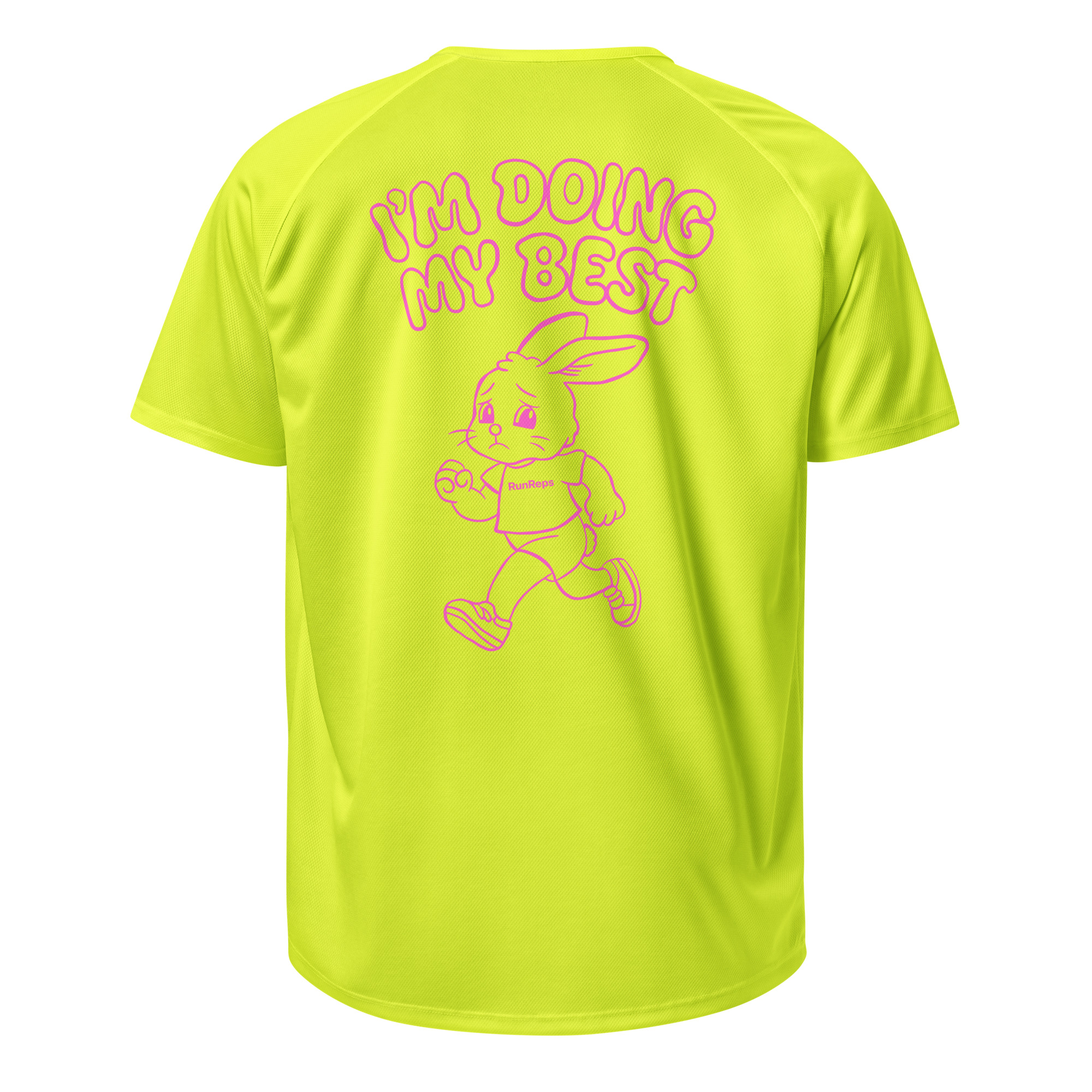
I'm Doing My Best Running Jersey
Lightweight, breathable unisex sports jersey in neon yellow. Designed for runners who keep showing up.
Free worldwide shipping on select orders
RunReps works with retail partners through the Awin affiliate network and earns a commission on qualifying purchases at no extra cost to you.
How the Pace Converter works
Enter a value in any pace or speed format. The converter instantly rewrites it into every other format, using the exact ratio of 1.609344 km to the mile. Click any row in the reference table to load that pace.
Embed this calculator on your site
Add this free calculator to your own website. Copy the snippet below and paste it into your page - it stays up to date automatically and links back to RunReps.
What running pace really tells you
Pace is time per unit of distance - minutes per kilometre or minutes per mile. It is the single number that links your effort to your result, and almost every decision a runner makes about training and racing revolves around it.
When you know your pace, you can project finish times, calibrate effort across different distances, and judge whether a session is hard, easy, or tempo. A 5:30/km easy run today and a 4:00/km race effort next weekend might feel completely different, but both communicate exactly where you are on the effort spectrum.
The problem is that running uses two parallel systems. Athletics, road racing, and most training tools outside the United States quote pace in minutes per kilometre. American races, many GPS watches sold in the US, and a substantial portion of English-language training plans use minutes per mile. When you cross between those systems - or when a training plan uses one format while your watch displays another - the numbers stop making intuitive sense instantly.
Speed in kilometres per hour adds a third format. It appears on treadmills, in fitness apps, and in physiological testing contexts. A speed of 10 km/h is exactly a 6:00/km pace, but holding that equivalence in your head under fatigue is surprisingly difficult.
This page does one job: it moves a pace between those formats without changing it. Working out what pace a goal finish time demands is a different question with a different answer, and the race pace calculator works out the pace you need for a goal time at any distance.
The same run, written four different ways
A single pace has at least four legitimate spellings, and none of them is more correct than the others. 5:00 per kilometre, 8:03 per mile, 12.0 km/h and 7.5 mph all describe one runner moving at one speed. Which one you see depends entirely on which device or which country is doing the talking.
The conversion itself rests on one number: a mile is 1.609344 km. Going from min/km to min/mile means multiplying by it, and going the other way means dividing. Speed is the reciprocal relationship rather than a multiple, which is where most mental arithmetic falls apart: 60 divided by your pace in minutes per kilometre gives km/h, so a faster pace produces a smaller number in one system and a larger number in the other.
That inversion is the reason treadmill sessions feel like a translation exercise. The display counts up in km/h while your training plan counts down in min/km, and the two move in opposite directions. Setting the belt to 12.0 rather than 11.0 is a 25-second-per-kilometre change, which is the difference between a steady run and a tempo effort.
The chart below covers the range most road runners train and race in. It is a quick sanity check rather than a substitute for the converter above, which handles the values in between and the ones that fall outside it.
| min/km | min/mile | km/h | mph |
|---|---|---|---|
| 4:00 | 6:26 | 15.0 | 9.3 |
| 4:30 | 7:15 | 13.3 | 8.3 |
| 5:00 | 8:03 | 12.0 | 7.5 |
| 5:30 | 8:51 | 10.9 | 6.8 |
| 6:00 | 9:39 | 10.0 | 6.2 |
| 6:30 | 10:28 | 9.2 | 5.7 |
| 7:00 | 11:16 | 8.6 | 5.3 |
min/km versus min/mile: when to use each
Minutes per kilometre is the global default for road running. If you are training in Europe, Australia, South Africa, or anywhere metric is the standard, your GPS watch almost certainly defaults to min/km, and most races will display kilometre splits on course signs. The metric system makes mental arithmetic easy: a 5:00/km pace over a 10K gives you 50 minutes - straightforward multiplication.
Minutes per mile is the default in the United States, and it persists in the UK alongside metric - partly because of the Boston Marathon and other historically mile-marked major races, and partly because many runners learned the sport via American training plans. If you follow a plan written in min/mile and race in a metric country, you will need to convert constantly to make sense of your split markers.
The two systems also create different intuitions about what a good pace looks like. A 7:00/mile sounds faster than a 4:21/km, even though they are exactly the same effort. Runners who switch countries or switch training systems often spend weeks recalibrating their sense of what numbers feel right.
Some GPS platforms let you display both simultaneously, but not all do. Apple Watch defaults to min/km or min/mile based on your device region. Garmin watches let you toggle between metric and imperial units from the settings menu. Strava follows your account preferences. If you travel to races internationally, it is worth checking your watch settings the night before - arriving at a race with your watch displaying the wrong unit is a minor but fixable headache that is easier to avoid.
A quick conversion reference: 1 mile is 1.609 km. To convert min/km to min/mile, multiply by 1.609. To convert min/mile to min/km, divide by 1.609. A 5:00/km pace is 8:03/mile. A 6:00/mile pace is 3:44/km. The converter above handles all of this instantly, so you never need to do the arithmetic by hand.
How to use the converter
Enter any single value - a pace in min/km, a pace in min/mile, or a speed in km/h - and the tool recalculates all three formats simultaneously. There is no submit button to press; results update as you type.
The most common use is a mismatch between a plan and a watch. If a session calls for 4:15/km but your watch is set to miles, type 4:15 into the min/km field and read 6:50/mile straight off. Treadmills work the same way in reverse: enter the km/h the belt is set to and you get the pace that session is actually asking of you.
It is worth doing this the night before rather than mid-session. Pick the unit you are going to run in, convert every pace in the week's plan into it once, and leave the watch alone. Switching units on the move is how a steady run turns into an accidental tempo.
The tool also helps when comparing performances across different formats. If a friend ran a 7:30/mile tempo session and you ran at 4:30/km, you can convert both to the same unit and see at a glance who was moving faster. (It was you, by about ten seconds per kilometre.)
One common misuse to avoid: do not use pace conversion to compare efforts at different distances without accounting for the fact that race pace scales with distance. A 4:00/km 5K pace is not the same physiological effort as a 4:00/km marathon pace - the marathon version would represent one of the fastest times in history. Pace is always contextual; this tool converts the number, not the effort behind it.
Frequently asked questions
How do I convert min/km to min/mile?
Multiply your min/km pace by 1.609344. A 5:00/km pace is 8:03/mile, and a 6:00/km pace is 9:39/mile. To go the other way, divide instead: a 7:00/mile pace is 4:21/km.
How do I convert km/h to min/km?
Divide 60 by your km/h speed. For example, 10 km/h → 60 ÷ 10 = 6:00 per km. The relationship is inverted rather than proportional, which is why a faster pace shows as a smaller number in min/km and a larger one in km/h.
Is pace the same as speed?
They are inverses of each other. Pace measures time per distance (min/km), speed measures distance per time (km/h). Lower pace = faster running.
What is a good running pace for beginners?
A comfortable pace for most beginner runners is 7:00–9:00 per km (11:00–14:00 per mile), or approximately 7–9 km/h. The right pace is one where you can hold a conversation - if you cannot speak in full sentences, you are going too fast.