In 2012, race-day temperatures in Boston hit 29 °C. Dropout rates tripled. Finish times ballooned. Runners who had trained for months crossed the line wondering what went wrong – or didn’t cross it at all. The difference between those who adapted and those who suffered often came down to one thing: they checked the forecast and changed their plan before the gun went off.

Boston Marathon weather is notoriously unpredictable. You can face sleet, headwinds, blazing sun, or all three in the same race. If you are running Boston on 20 April 2026, the smartest thing you can do this week is check the race day weather forecast on RainOrRun and adjust your pacing strategy before you pin on your bib.
This guide shows you exactly how to do that – step by step – using RainOrRun for live conditions and RunReps pace tools to translate the forecast into a race plan that works.
Why Boston Marathon Weather Deserves Its Own Race Plan
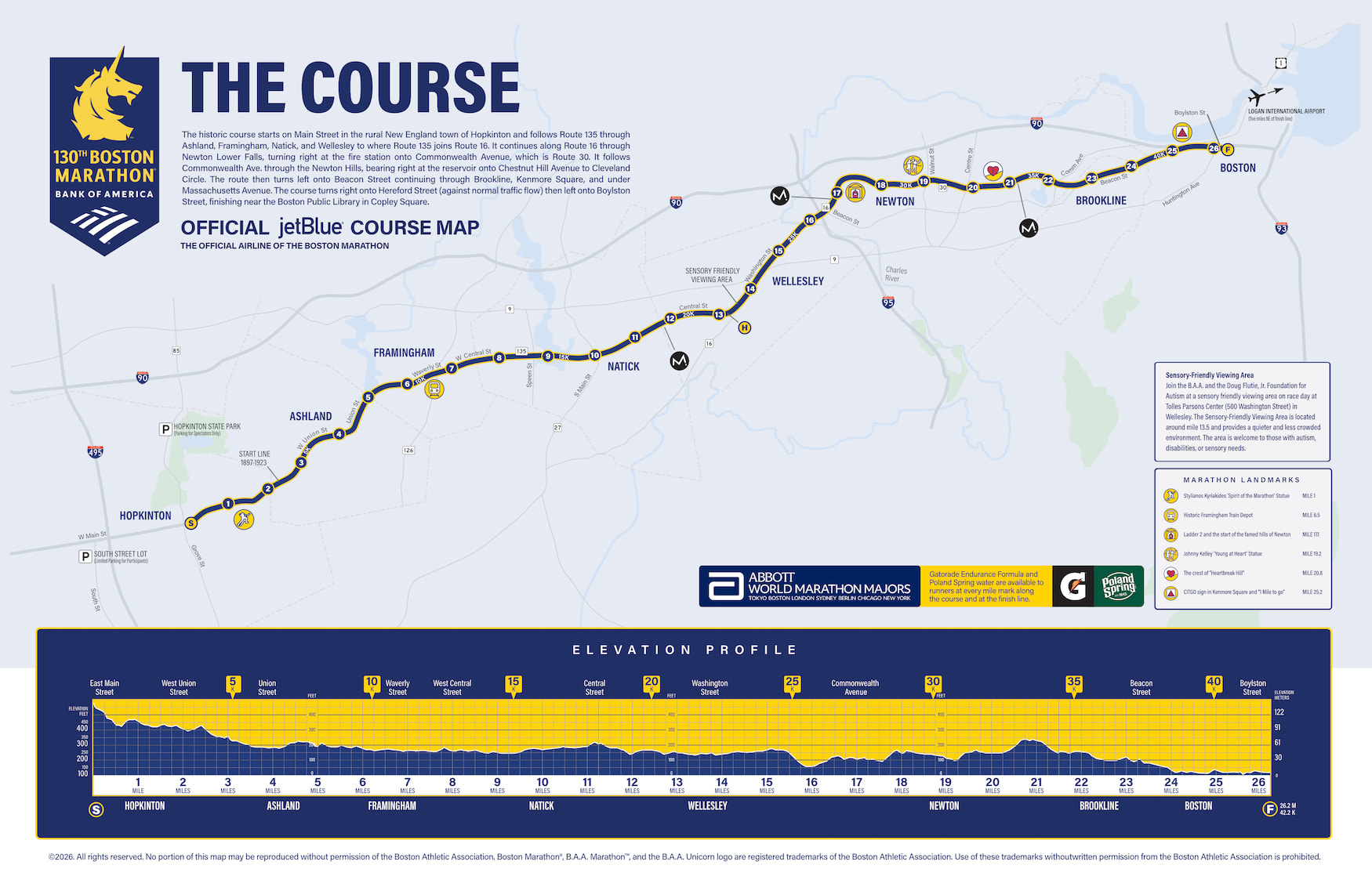
Boston is a point-to-point course that starts inland in Hopkinton and finishes on Boylston Street downtown. That 42 km stretch crosses microclimates. The first 10 km is often cooler and sheltered. By the time you reach the Newton hills around the 26 km mark, sun exposure, wind, and rising temperatures can hit you hard – especially if you went out at a pace set for milder conditions.
Research from Dr George Chiampas and the Chicago Marathon medical team, published in the British Journal of Sports Medicine, found that marathon performance degrades measurably once temperatures exceed 15 °C. For every 5 °C above that threshold, average finish times slow by 1.5 to 3 percent. A study by Ely et al. (2007) in Medicine and Science in Sports and Exercise confirmed that even modest heat increases disproportionately affect slower runners, with finishing times for mid-pack athletes degrading twice as fast as those of elite competitors.
Rain introduces its own problems. Wet shoes add weight. Chafing worsens. Grip on downhill sections – particularly the steep descents before Heartbreak Hill – becomes a genuine safety concern. Wind on an exposed point-to-point course can turn an easy opening half into a battle.
The bottom line: a pace that works in 10 °C and calm conditions is not the same pace you should run in 22 °C with a headwind. Knowing the forecast is step one. Adjusting your plan is step two.
How to Check Boston Marathon Conditions on RainOrRun
RainOrRun is built for exactly this situation. It gives you race-specific weather data – not a generic city forecast, but conditions mapped to the course and the time you will be running.
Here is how to use it before Boston:
- Visit RainOrRun.com and search for the Boston Marathon. You will see the race-day forecast broken down by time of day, covering temperature, precipitation probability, wind speed, and humidity.
- Note the temperature range for your expected finish window. If you are aiming for a 3:30:00 to 4:00:00 finish, you will be running from roughly 10:00 to 14:00 local time. Afternoon conditions are often 5-8 °C warmer than the start.
- Check the wind direction. Boston runs roughly west to east. A westerly wind is a tailwind (helpful). An easterly wind is a headwind that will cost you energy, particularly on the exposed stretch between kilometres 18 and 32.
- Look at precipitation probability. If rain is forecast, plan your kit accordingly – a lightweight cap, anti-chafe balm, and a throwaway layer for the start corral.
Adjusting Your Marathon Pace for Weather Conditions
Once you have the forecast, you need to convert it into a revised race plan. This is where most runners fall short – they see the weather, acknowledge it, and then run their original pace anyway.
Here is a practical framework for marathon pace adjustment based on conditions:
- Temperature 10-15 °C, low humidity: Ideal. Run your target pace as planned.
- Temperature 16-20 °C: Slow your target pace by 10-20 seconds per kilometre. Start conservatively and reassess at halfway.
- Temperature above 20 °C: Slow by 20-40 seconds per kilometre. Shift your goal from a time target to finishing strong. Hydrate early and often.
- Rain (light to moderate): Pace impact is minimal, but increase caution on descents. Expect your shoes to gain 50-100 g of water weight.
- Headwind above 20 km/h: Budget an extra 5-15 seconds per kilometre on exposed sections. Tuck behind other runners when you can.
Plug your adjusted target into the split time calculator to see what each mile and kilometre split should look like under your revised plan. If you are planning a conservative first half with a stronger finish, the negative split calculator will map that out for you.
A Race Plan That Changed on Thursday Night

Picture this. It is Thursday, 17 April. You are in Boston, carb-loading, and feeling ready. Your goal is 3:45:00 – a pace of roughly 5:20 per kilometre. You have trained for it. You have earned it.
Then you check RainOrRun and see the Sunday forecast: 23 °C by midday, humidity at 65 percent, light southerly wind. That is not what you trained in back home in Manchester through a British winter.
Instead of panicking, you open the RunReps pace calculator and recalculate. At 23 °C, you decide to slow your opening pace to 5:35 per kilometre – banking energy for the Newton hills and the final 10 km when the heat peaks. You run the numbers through the split time calculator and print a new pace band.
On race day, you pass dozens of runners walking by kilometre 35 – runners who went out at their original pace and paid the price. You finish in 3:52:00. Not a PB, but a smart race. You crossed the line running, not shuffling. That is what preparation looks like.
What to Wear When Boston Weather Turns
Kit choices on race morning depend entirely on what RainOrRun shows you the night before. Here are the broad guidelines:
- Below 10 °C: Arm sleeves or a long-sleeve base layer. Gloves for the first half. A bin bag for the start corral.
- 10-18 °C: Singlet and shorts for most runners. Arm sleeves optional. This is the sweet spot.
- Above 18 °C: Lightest kit possible. Light-coloured fabrics. A cap to shield from direct sun. Consider a visor if you overheat easily.
- Rain forecast: A lightweight cap keeps water out of your eyes. Anti-chafe balm on every skin fold. Avoid cotton entirely – it holds moisture and doubles in weight.
For training runs in the days before the race, RunConditions gives you a quick read on local air quality, humidity, and heat index so you can plan your shakeout runs safely.
Three Weather Scenarios and How to Race Each One
Cool and dry (8-14 °C, no rain, light wind)
This is your green light. Stick to your trained pace. Focus on even splits or a slight negative split through the Newton hills. Use the negative split calculator to set your second-half target 10-15 seconds per kilometre faster than your first half.
Warm and humid (18-25 °C, humidity above 60 percent)
Dial back 15-30 seconds per kilometre from the start. Take water at every station, not every other station. Pour water on your neck and wrists. Accept that today is not a PB day – it is a survival-and-strength day.
Running in the rain with headwind
Protect your feet with petroleum jelly to reduce blister risk. Run close to other athletes on exposed stretches to share the wind load. On downhill sections, shorten your stride to keep traction. Your pace will naturally slow on windward sections – let it. Make up time on sheltered stretches.
When to Check and When to Stop Checking
Weather forecasts for a specific race day become meaningfully accurate from about five days out. Here is a sensible schedule:
- Tuesday 15 April: First check on RainOrRun. Get a general sense of the temperature range and precipitation risk. Do not make kit or pace decisions yet.
- Thursday 17 April: Second check. The forecast is now reliable enough to plan your kit and revise your pace targets. Run adjusted numbers through the pace calculator.
- Saturday 19 April (evening): Final check. Confirm your race-morning kit, set your watch to your adjusted pace, and print or screenshot your split times. Then stop. Sleep well. Trust the plan.
Checking the forecast every hour on Saturday night will not make the weather better. It will make your sleep worse. Check once, plan once, race once.
Boston Marathon Weather Questions Runners Ask
How does weather affect marathon performance?
Temperature is the biggest factor. Research published in Medicine and Science in Sports and Exercise shows that finish times increase significantly above 15 °C, with mid-pack runners losing 1.5 to 3 percent per 5 °C increase. Humidity compounds the effect by reducing your body’s ability to cool through sweat evaporation. Wind adds mechanical resistance on exposed sections, and rain increases shoe weight and chafing risk. The combined effect of heat, humidity, and wind can add 10 to 20 minutes to a 4-hour marathon finish.
What is the average temperature for the Boston Marathon?
Historical averages for race day in mid-to-late April sit between 10 °C and 16 °C, but Boston is infamous for outliers. The 2012 race hit 29 °C. The 2018 race brought 3 °C temperatures with driving rain and headwinds. Relying on averages is a mistake – check the actual forecast on RainOrRun from Tuesday of race week onward for conditions specific to 20 April 2026.
Should I change my marathon goal time because of weather?
Yes, if conditions are outside the 10-15 °C ideal window. Adjusting your pace by 10-30 seconds per kilometre in warm conditions is not giving up – it is racing smart. Use the pace calculator to see what your adjusted finish time looks like, and set your splits accordingly. Runners who adjust proactively almost always finish faster than those who go out hard and fade.
What should I wear for the Boston Marathon if it rains?
A lightweight running cap is the single most useful item – it keeps rain out of your eyes and off your face. Apply anti-chafe balm liberally before the race. Wear synthetic fabrics only; cotton absorbs water and creates drag and discomfort. Consider a disposable poncho or bin bag for the start corral, which you can discard after the first kilometre once you are warm.
Weather conditions vary and forecasts are estimates. Always use your own judgement on race day and consult event organisers for official guidance on extreme weather protocols. Adjust pace and hydration based on how your body feels, not numbers alone.
Empfohlene Laufausruestung
Ob Anfaenger oder erfahrener Laeufer - diese Produkte eignen sich fuer die meisten Laeufer.
Garmin Forerunner 265
Die beste GPS-Uhr der Mittelklasse. AMOLED-Display, praezise Pace-Erfassung und Trainingsbelastungsanalyse.
Auf Amazon ansehenNike Pegasus
Ein vielseitiger Alltagstrainer fuer lockere Laeufe, Tempoeinheiten und Wettkampftage.
Auf Amazon ansehenFaszienrolle
Hilft bei der Regeneration nach dem Laufen. Ein einfaches Werkzeug gegen Muskelkater.
Auf Amazon ansehen