You have put in four months of training. You have done the long runs, survived the tempo sessions, and negotiated Sunday mornings away from the family. Now somebody asks the question every marathoner dreads: “What time are you going for?”

Most runners answer with a number pulled from thin air – a round figure that sounds respectable, or the time their mate ran last year. The problem is that guessing your marathon finish time is not just inaccurate. It is dangerous. An over-ambitious target leads to a blown-up race. An under-ambitious one wastes months of hard work. There is a better way, and it starts with a shorter race you have already run.
Why Your 5 km Time Is a Better Predictor Than Your Training Pace
When runners try to predict their marathon finish time, the most common mistake is extrapolating from training runs. “I ran 20 km at 5:30 min/km, so I should be able to hold that for 42.2 km.” The logic feels sound, but it falls apart because training pace and race pace operate under different physiological conditions. Once a shorter race gives you a trustworthy target time, the next job is spreading it across the two halves, which is exactly what how to calculate a negative split sets out.
A 20 km training run is performed at a controlled effort, often with fuel stops, walk breaks, or a conservative mindset. A race result from a shorter distance – 5 km, 10 km, or a half marathon – captures your genuine maximal sustainable effort for that duration. That is a far more reliable data point.
Exercise physiologist Pete Riegel demonstrated this in his landmark study on athletic performance prediction. His formula, first published in 1977 and refined over subsequent decades, models the relationship between race distance and time using an exponential fatigue factor (Riegel, 1981). The principle is straightforward: the longer the race, the slower your average pace, and the rate of slowdown is predictable across distances. What the formula does not account for is body weight, so run your figures through the weight vs pace calculator if yours has shifted since your last 5 km.
A well-executed 5 km race tells a prediction model everything it needs to know about your current aerobic capacity, your pace efficiency, and your tolerance for sustained hard effort. From there, the maths does the rest.
How Race Time Prediction Models Work

The two most widely used prediction frameworks are Riegel’s formula and Jack Daniels’ VDOT system. Both aim to answer the same question: given your performance at one distance, what should you be capable of at another?
Riegel’s formula uses a simple exponential model. It takes your known race time, the known distance, and the target distance, then applies a fatigue exponent (typically 1.06 for recreational runners) to estimate the slowdown. It works well for runners who have a solid aerobic base and consistent training.
Daniels’ VDOT system takes a different approach. It assigns a single fitness score – your VDOT – based on a race result, then maps that score to equivalent performances across all standard distances (Daniels, 2014). A runner with a VDOT of 45, for example, might run a 5 km in 21:36 and a marathon in 3:32:00. The VDOT tables assume comparable training at each distance, which is an important caveat.
Both models agree on the fundamentals. A 25:00 5 km runner is not a 3:30 marathoner. They are closer to 3:50-3:55 – and that 20-minute difference between hope and reality is exactly where races fall apart.
Coach’s insight: Prediction models tell you what you are physiologically capable of, not what you will achieve on the day. Think of the predicted time as a ceiling. Your job in training is to get as close to that ceiling as possible, and your job on race day is to not start above it.
How to Predict Your Marathon Finish Time Step by Step
Step 1: Get a recent race result
You need a timed effort from the last 8-12 weeks. A parkrun 5 km is ideal because it is free, timed, and competitive enough to push you. A 10 km race or a well-paced half marathon works too. The key is that it must be a genuine race effort – not a comfortable training run. If you do not have a recent result, run a solo 5 km time trial on a flat, measured course.
Step 2: Enter your data into the Race Time Predictor
Open the RunReps Race Time Predictor. Enter your race distance and finish time. The tool will calculate your predicted finish times across all standard distances, including the marathon. It applies established prediction models so you do not have to do the maths yourself.
Step 3: Check the prediction against your training
The predicted time assumes you have trained appropriately for the marathon distance. If your longest run is 25 km and you have only been training for eight weeks, the prediction may be optimistic. If you have completed a full 16-20 week programme with long runs up to 32-35 km, the prediction should be realistic.
Step 4: Set your race pace
Take your predicted marathon time and convert it to a per-kilometre pace using the Pace Calculator. A predicted time of 3:52:00 gives you a target pace of approximately 5:30 min/km. Write it down, programme it into your watch, and commit to it from kilometre one.
When Predictions Are Reliable – and When They Break Down
Race time predictors are remarkably accurate for a specific type of runner: someone with consistent training over 12 or more weeks, recent race experience at a shorter distance, and a flat course in moderate conditions. For that profile, predictions typically land within 2-3% of actual finish times.
But predictions can break down in several common scenarios.
First-time marathoners. If you have never raced beyond a half marathon, your body has not proven it can handle the last 10 km. The prediction model assumes equivalent training, but no amount of 5 km fitness replaces the specific endurance needed for the final third of a marathon. First-timers should add 5-10% to their predicted time as a buffer.
Heat and humidity. Research from the American College of Sports Medicine shows that marathon performance degrades significantly above 12 degrees Celsius, with the effect accelerating as temperatures rise (Ely et al., 2007). A runner predicted to finish in 3:45:00 in cool conditions might realistically run 3:55:00 to 4:05:00 on a warm day. Most prediction models do not account for weather. They do not account for body weight either, so if yours has shifted since the race you are predicting from, check how much faster you run per kilogram lost before you commit to the number.
Hilly courses. Prediction models assume a flat course. Net elevation gain costs time, even if you gain some of it back on the descents. For a course with significant hills, add 1-2 seconds per kilometre for every 10 metres of net elevation gain per kilometre.
Insufficient long run training. If your longest run was 24 km and you are predicting a marathon time from a 5 km result, the model is technically correct but practically misleading. You have the aerobic engine for that time, but you have not built the muscular endurance or fuelling experience to sustain it for 42.2 km.
Adjusting Your Prediction for Real-World Conditions

Once you have a baseline prediction, adjust it for the specifics of your race.
Temperature: Add 1-2 minutes for every 5 degrees above 15 degrees Celsius. If race day is forecast at 25 degrees, your 3:45:00 prediction becomes 3:49:00 to 3:53:00.
Course profile: Check the elevation chart. A flat course like Berlin needs no adjustment. A course like Boston, with its hills in the second half, might cost you 3-5 minutes compared to a flat prediction.
Wind: A sustained headwind of 15-20 km/h can add 2-4 minutes to your finish time. Tailwinds help, but not by the same margin – they typically recover about half of what a headwind costs.
Experience: If this is your first marathon, err on the conservative side. If you have three or four marathons behind you and your prediction aligns with your best recent result, trust it.
For race-day execution, use the Negative Split Calculator to plan a conservative first half with a faster finish. Starting 5-10 seconds per kilometre slower than your target average pace gives you a cushion for the final 10 km when fatigue sets in.
Why Training Pace Is Not the Same as Race Pace
One persistent myth is that your training pace reveals your race potential. It does not – at least, not directly. Most of your training should be run at easy pace, which is 60-90 seconds per kilometre slower than marathon race pace. If your predicted marathon pace is 5:30 min/km, your typical easy runs should land around 6:30-7:00 min/km.
The purpose of easy running is to build aerobic capacity without accumulating excessive fatigue. It is the foundation that makes race pace sustainable. Runners who train at race pace every day do not get faster. They get injured or overtrained.
Your race pace is confirmed by race results, not by what feels fast on a Tuesday morning. That is exactly why prediction models based on race data work better than any amount of guesswork.
What Distance Should You Predict From?
Is a 5 km or 10 km result better for predicting marathon time?
Both work, but a 10 km or half marathon result gives a slightly more reliable prediction because the distance is closer to the marathon. That said, a well-raced 5 km is more useful than a badly paced half marathon. The quality of the effort matters more than the distance.
Can you predict marathon time from a half marathon?
Yes, and it is the most accurate shorter-distance predictor. A common rule of thumb is to double your half marathon time and add 10-15 minutes. Prediction models refine this with the fatigue exponent, but the doubling method gets you in the right range. A 1:45:00 half marathon predicts a marathon time of roughly 3:40:00 to 3:45:00.
How often should you re-run a prediction?
Every time you complete a new race or time trial. Your fitness changes through a training block, and a prediction from week four does not reflect your fitness at week sixteen. Re-test with a parkrun or 10 km race four to six weeks before your marathon for the most current prediction.
This article is for informational purposes. Race time predictions are estimates based on mathematical models and may not account for individual health conditions, course-specific factors, or environmental variables. Always consult a qualified coach or medical professional before making significant changes to your training programme.
Race day essentials
Having the right kit on race day removes one more variable. These items help you execute your race plan with confidence.
Garmin Forerunner 265
Live pace alerts and lap tracking keep you honest on race day. The AMOLED display is easy to read mid-race.
View on AmazonSiS Go Energy Gels
Isotonic gels that go down easily during a race. No need to find a water station to wash them down.
View on AmazonRunning Belt
Carry gels, phone, and keys without bouncing. A simple belt keeps everything secure so you can focus on your pace.
View on Amazon
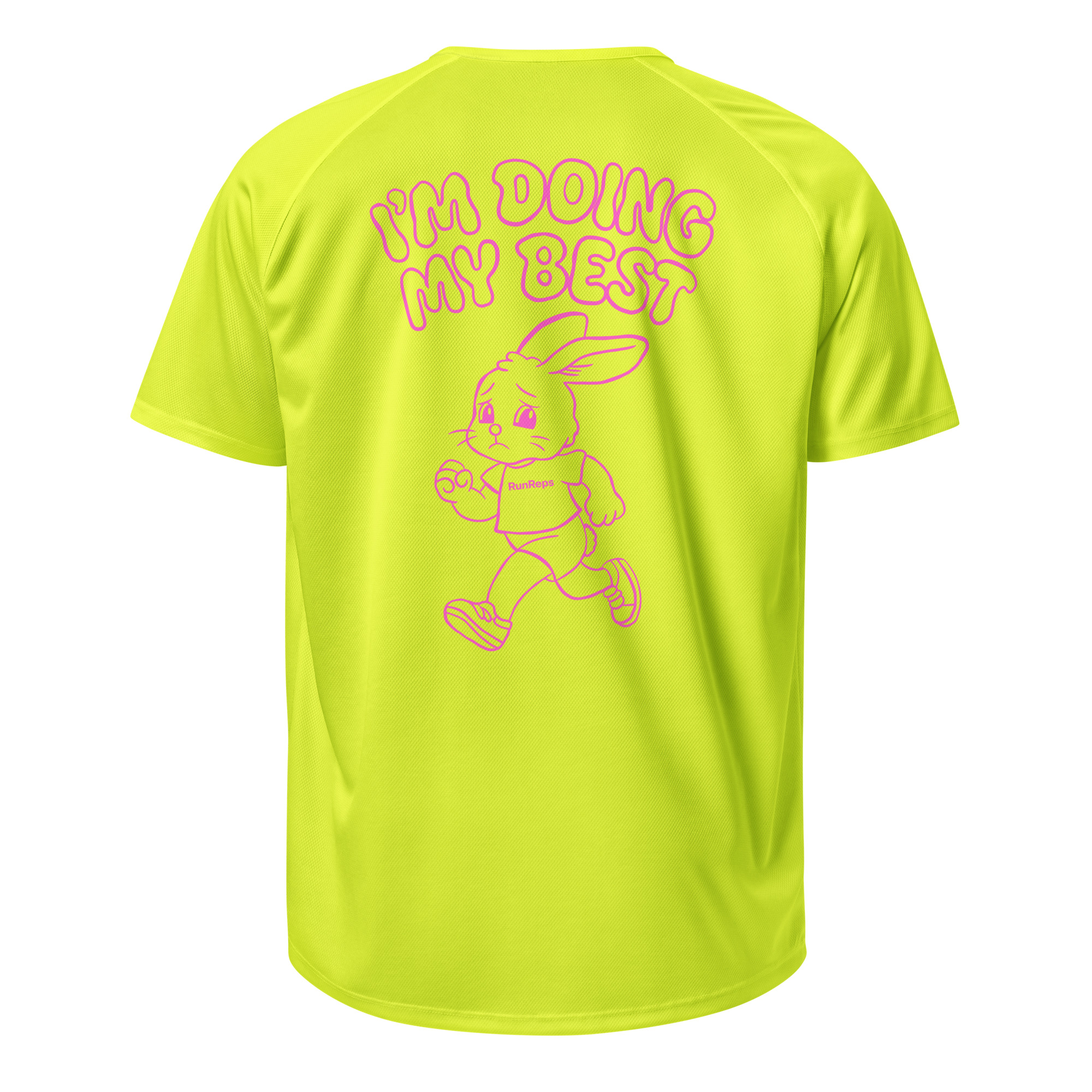
I'm Doing My Best Running Jersey
Lightweight, breathable unisex sports jersey in neon yellow. Designed for runners who keep showing up.
Free worldwide shipping on select orders
RunReps works with retail partners through the Awin affiliate network and earns a commission on qualifying purchases at no extra cost to you.
