The medal is on the hook, the legs are forgiven, and the question shows up faster than the soreness fades: what now? Building a sensible summer racing season plan after a spring marathon is the difference between cashing in 16 weeks of fitness and watching it leak away over a few aimless June weekends. The good news is that you do not need to start over. The fitness is there. The job is to point it at the right races, the right distances, and the right training, then to ride that fitness into August in one piece.

This guide walks you through the spring to summer running transition step by step. You will pick the right race distance for your post-marathon body, project realistic times from your marathon performance, build a 6 to 12 week summer plan, manage the heat as the season warms up, and slot a few sensible races into a calendar that gets you to autumn fresher and faster than you started.
Why your spring marathon is a launchpad, not a finish line
A marathon empties the tank. It also leaves a lot of buried treasure behind: aerobic base, mitochondrial density, fat-burning efficiency, leg durability, and a head that has done a hard thing and can do hard things again. Most runners lose around 5 to 10% of VO2 max within two to three weeks of stopping training entirely, but lose far less if they keep ticking over with easy runs and a little intensity. The mistake is not running too soon. It is running with no plan.
Set the rebuild up in three phases. First, recover for 10 to 14 days with easy walks, short jogs, and zero hard sessions. Second, rebuild for two weeks with relaxed easy mileage at 50 to 70% of your peak marathon volume and one gentle stride session a week. Third, repurpose the engine: shift the work from long, slow distance to shorter, sharper sessions that suit a 5K, 10K or half marathon target. Skip phase one and you carry fatigue into June. Skip phase three and you turn up to a flat 5K race with a marathon runner’s gears – smooth at 5:00 min/km, clueless above 4:00.
How to choose summer races that fit your body

The right summer race is not the most exciting one on the calendar. It is the one your current fitness can attack without forcing a second 16-week build. Three honest options after a spring marathon:
- 5K (4 to 6 weeks out). Best if you want to feel sharp again quickly. The work is short and intense. The recovery is short. You will feel slow for the first two weeks and then suddenly, somewhere in week four, you will run a session that reminds you what fast feels like.
- 10K (6 to 10 weeks out). The sweet spot for most spring marathoners. Your aerobic base is huge, your threshold is already strong, and a 10K rewards both. Ten weeks gives you time to add 5K-style speed without losing endurance. Beginners and returners may find a structured plan invaluable – the principles in our guide on how to train for a 10K run apply just as cleanly to a post-marathon block as a from-scratch one.
- Half marathon (10 to 14 weeks out). A natural extension of the marathon engine. The risk is mental, not physical: too many hard sessions stacked on lingering marathon fatigue. Keep the long run honest, the threshold work consistent, and you will run a strong summer half off a much shorter build than you would normally need.
Avoid stacking two summer goal races in the same six-week window. One A-race, one or two B-races, and the rest as training. That is enough.
Project your summer times from your marathon
Your spring marathon time is a high-quality data point. Treat it like one. Plug your marathon finish into a Riegel-based predictor and you get a strong starting estimate for what your current fitness can run over a 5K, 10K or half marathon. The race time predictor takes a known time and distance and projects across the rest. A 3:30 marathon, for example, projects to roughly 21:50 for a 5K, 45:25 for a 10K, and 1:40 for a half – assuming honest training continues.
Two adjustments. First, marathon predictions tend to flatter shorter races for runners with strong endurance and weak speed – more on that below. Second, summer conditions hurt times. Most runners lose 1 to 4% of pace once temperatures climb above roughly 18 degC, with humidity and direct sun making it worse. Use the predictor as your ceiling on a cool, flat day and shave a small percentage off for any race day that is genuinely hot.
Re-predict every three to four weeks during the build. A fresh parkrun, a tempo run on a track, or a tune-up race feeds the predictor with sharper data than a six-week-old marathon time. The faster your shorter races trend, the closer your speed work is moving you to your true summer ceiling.
Build a 6 to 12 week summer training plan
The summer build looks different to a marathon block. Volume drops slightly. Intensity rises. Long runs shrink and turn into quality long runs. The rough shape:
- Weeks 1 to 2 (recovery and rebuild). Easy runs only. Build to 60 to 70% of marathon peak weekly mileage. Add one short stride session in week two – 6 to 8 efforts of 80 m at fast-but-relaxed effort.
- Weeks 3 to 5 (sharpen). Add one threshold or tempo session per week (20 to 30 minutes at a comfortably hard pace), one easy long run of 80 to 100 minutes, and three to four easy runs.
- Weeks 6 to 8 (specific work). Replace the threshold session with a race-pace workout once a week – 5 x 1 km at 10K pace, or 4 x 5 minutes at half marathon pace. Keep the long run, drop one easy day to add a strides-after-easy-run day.
- Final 7 to 10 days (taper). Cut volume by 30 to 50%. Keep one short race-pace session in the final week. Sleep more. Run less.
If structuring this yourself feels like one decision too many in a hot July, the running plan generator will produce a personalised plan for your race distance, current fitness and available days. Use the marathon-derived times as the baseline. Re-run the plan if you switch goal race or your fitness jumps after a strong tune-up.
Across all three distances, two principles hold. Easy days stay easy – the temptation to “just push it a bit” is exactly the same trap that ruins marathon builds. And one quality session is plenty in a hot week. Two is sometimes possible. Three is asking for an injury when the temperature climbs.
Train through the heat without breaking yourself
Summer training breaks more runners than winter does. Heat raises heart rate at the same pace, dehydrates you faster than you notice, and rewards runners who respect it with surprisingly fast autumn races. The basic rules:
- Run early or late. A 6:30 am easy run is a different sport to a 1 pm one. The sun is the variable, not the air temperature.
- Slow down on hot days. A useful rule of thumb from research summarised by the American College of Sports Medicine: expect to run roughly 1 to 3% slower at 20 degC than at 10 degC, 4 to 6% slower at 25 degC, and significantly more once humidity is high or you are running in direct sun. Pace by feel and heart rate, not the spreadsheet.
- Hydrate properly. 400 to 600 ml of fluid per hour during longer runs, with sodium for any session over 75 minutes. Pre-cool with cold drinks before a hot session. Do not start a long run dehydrated.
- Acclimatise gradually. Studies on heat acclimatisation, including work published by the Journal of Applied Physiology, show meaningful adaptation in 10 to 14 days of regular exposure to warm conditions. The first hot week feels brutal. The third does not.
- Check conditions before you head out. Air quality, humidity and heat index can change session-by-session in summer. Use a service like RunConditions to check today’s running conditions before you commit to a hard workout in unknown air.
Heat illness is real. If you experience dizziness, nausea, confusion or stop sweating during a hot run, stop immediately, cool down, and seek medical advice if symptoms persist. This article is for general guidance and does not replace medical advice for runners with pre-existing conditions or returning from injury.
A sample UK and global summer race calendar

What does a workable post-marathon summer calendar actually look like? Here is a typical UK-based runner who finished London in late April. The principles travel – swap in your local equivalents.
- Late May: Local 5K parkrun tune-up. Effort, not all-out. Use the time to feed the predictor.
- Mid June: A weekday 10K – club race, midweek city series, or a Run Through 10K. This is your B-race. Aim for marathon-projected pace, give or take heat.
- Early July: A flat, fast 10K targeting a personal best. The Boundary 10K, Newport 10K or a similar fast circuit. This is the A-race.
- Late July or early August: A 5K shootout – parkrun All-Comers, a track 5K, or a charity event. Sharp, short, optional.
If the half marathon is your A-race, push the calendar back. Tune-up 5K in early June, tune-up 10K in early July, A-race half marathon in late August or early September. Globally, the major summer flat-and-fast options include the Bolder Boulder 10K (USA, late May), the Atlanta Peachtree Road Race 10K (USA, July 4), and the Berlin Big 25 (Germany, May). Track meets through July and August are the best speed playground for runners who want to test their leg speed under controlled conditions.
Whichever calendar you choose, anchor it on goals you have actually written down. Our guide on setting running goals for 2026 from 5K to marathon gives you a framework for turning a vague “run faster” into a specific summer time you can train towards.
One runner, one summer plan
Take Sam, a 41-year-old club runner who finished the London Marathon in 3:18 in late April. Goal for the summer: a sub-40 10K in early July, ten weeks out. The marathon predictor projects him at roughly 42:30 for a 10K from his current fitness – a clear gap to close. His plan looks like this. Two weeks of recovery and easy mileage. Three weeks of sharpening with one tempo session and one strides session. Five weeks of 10K-specific work with one race-pace session, one long aerobic run, and one B-race tune-up parkrun in week seven where he runs 19:40. He arrives at the 10K with race-rusty legs but a real chance, runs 39:48, and goes into August with confidence and zero injuries. The plan worked because he respected the recovery, projected from real data, and trained for the distance he was actually racing.
For runners coming back from a longer layoff before their spring marathon, the timeline-of-fitness piece in our guide on how long it takes to get fit for a 5K, 10K or half marathon gives realistic windows for each distance and pairs nicely with this summer planning approach.
Common questions about your summer racing season plan
How long should I rest after a spring marathon before racing again?
Most runners need 10 to 14 days of true recovery (easy runs and walks only) and another two weeks of relaxed mileage before any quality work. That puts a 5K race comfortably in week four, a 10K race in week six to eight, and a half marathon ten weeks plus. If your marathon was a hot or hilly one, add a week. The fastest summer races come from runners who took the first fortnight properly easy.
How do I choose between a summer 5K, 10K and half marathon?
Your spring marathon left you with strong endurance and modest top-end speed. A summer 10K rewards that mix the most. Pick a 5K if you want a quick sharpening cycle and to feel fast again. Pick a half marathon if you want to build off your marathon endurance and have ten weeks plus. Choosing summer races is also about what you actually enjoy – a fast flat 10K beats a hilly half if you want a personal best on a hot day.
Will heat ruin my summer race times?
Heat slows almost every runner. Expect roughly 1 to 3% slower at 20 degC, 4 to 6% slower at 25 degC, and worse with high humidity or direct sun. The fix is not to fight it but to plan for it. Race early in the day where possible, hydrate properly, acclimatise gradually over 10 to 14 days, and adjust pacing based on real-time conditions. A summer training plan that includes heat exposure produces better autumn races, not just better summer ones.
Should I do speedwork while still recovering from a marathon?
Not in the first two weeks. Strides (short, fast bursts of 60 to 100 m at controlled effort) are fine from week two or three because they are short enough to avoid systemic load. True intervals – 1 km repeats, mile repeats, hard tempo runs – belong in week four onwards once the marathon fatigue has cleared. Pushing intensity onto unrecovered legs is the most common cause of summer injury in runners coming off a spring marathon.
Do I need a different training plan for summer than for winter?
Yes, in two ways. The structure changes – shorter goal distances, more intensity, less long-slow-distance work. And the conditions change – heat acclimatisation, earlier start times, more frequent hydration. The training plan summer build is more about quality than volume, and more about timing of sessions than mileage totals. The running plan generator can build that for you in a couple of clicks.
Spring marathons buy you summer fitness. Spend it. Pick one A-race, two tune-ups, and a sensible build. Project from your marathon, predict honestly, and respect the heat. The runners who close out summer fastest are the ones who treated April as a foundation, not a finale.
Once you have your summer goal time, build the plan that gets you there. The running plan generator turns your target race, fitness level and weekly availability into a structured 6 to 12 week summer block. Pair it with the predictor and you have the two tools you need from now until your A-race.
Race day essentials
Having the right kit on race day removes one more variable. These items help you execute your race plan with confidence.
Garmin Forerunner 265
Live pace alerts and lap tracking keep you honest on race day. The AMOLED display is easy to read mid-race.
View on AmazonSiS Go Energy Gels
Isotonic gels that go down easily during a race. No need to find a water station to wash them down.
View on AmazonRunning Belt
Carry gels, phone, and keys without bouncing. A simple belt keeps everything secure so you can focus on your pace.
View on AmazonNike Pegasus
Handles easy runs, tempo work, and long runs. A versatile daily trainer that suits most training plans.
View on Amazon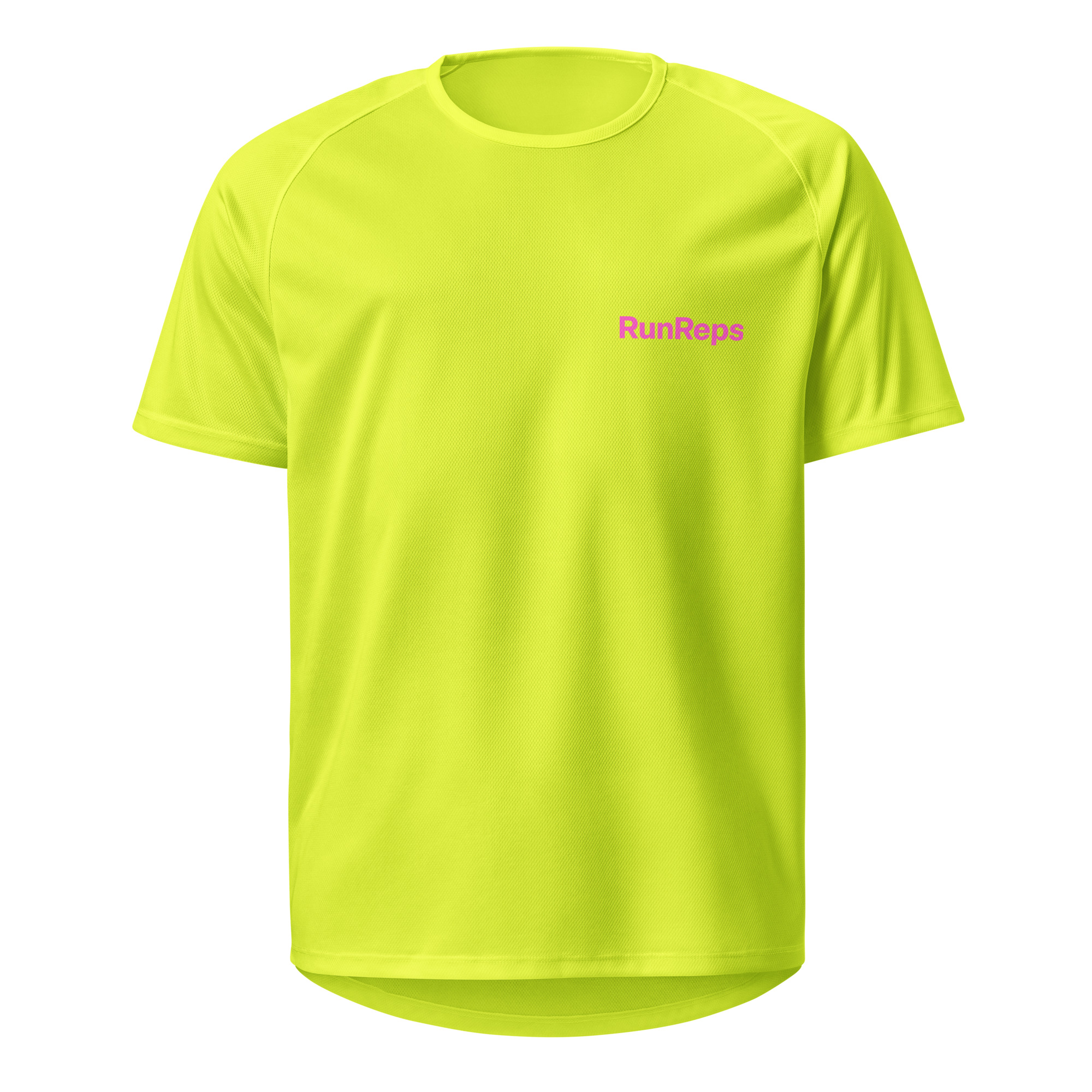

I'm Doing My Best Running Jersey
Lightweight, breathable unisex sports jersey in neon yellow. Designed for runners who keep showing up.
Free worldwide shipping on select orders
RunReps works with retail partners through the Awin affiliate network and earns a commission on qualifying purchases at no extra cost to you.