Pace Band Generator
Generate a printable pace band with split and cumulative times for your target race time - every kilometre for 5K and 10K, every 5 km for the half and marathon. Screenshot or print to take on race day.
Race day essentials
A pace band works best alongside a GPS watch and race nutrition. Be fully prepared for your next event.
Garmin Forerunner 265
Real-time pace data to complement your printed pace band. AMOLED display is easy to read mid-race.
View on AmazonSiS Energy Gels
Plan your gel intake at specific pace band checkpoints. Easy to carry and digest during racing.
View on AmazonRunning Belt
Carry your gels, phone and pace band without bouncing. Essential for an organised race day.
View on Amazon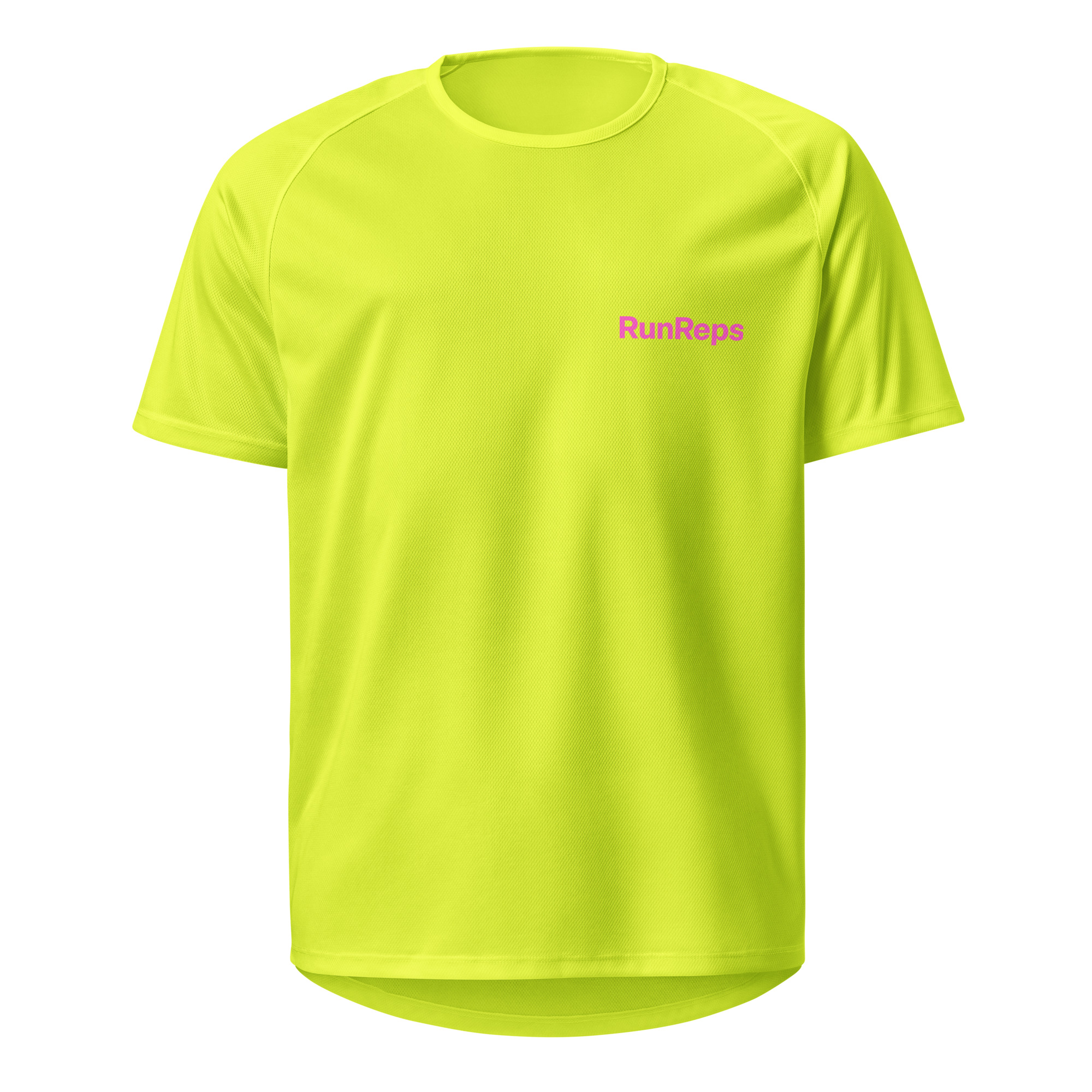
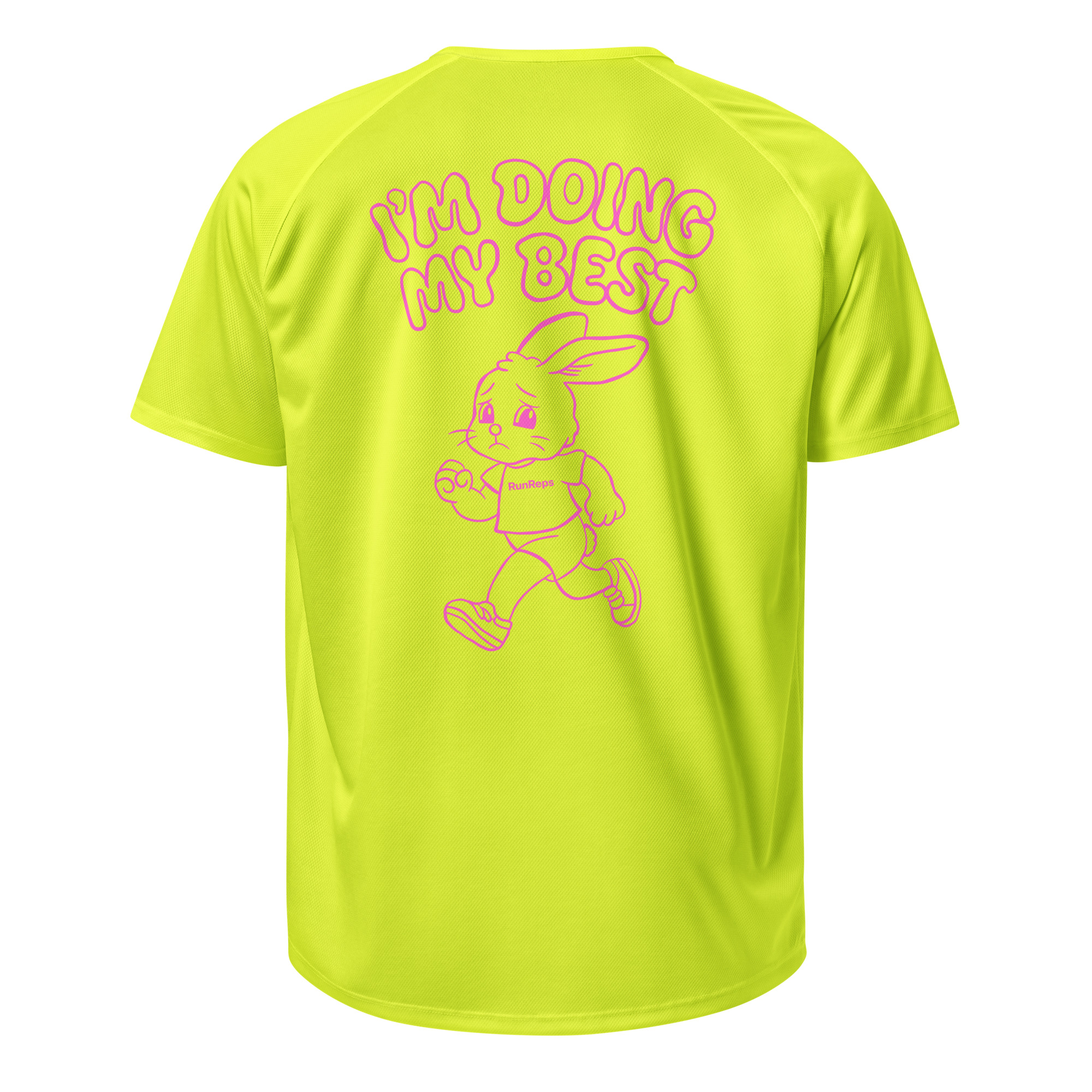
I'm Doing My Best Running Jersey
Lightweight, breathable unisex sports jersey in neon yellow. Designed for runners who keep showing up.
Free worldwide shipping on select orders
RunReps works with retail partners through the Awin affiliate network and earns a commission on qualifying purchases at no extra cost to you.
Marathon training plans
Structured marathon plans from beginner finisher to sub-4 hour, with weekly mileage progression and taper guidance.
Beginners Marathon Finisher Plan
£6.99
Breaking the 4 Hour Marathon Training Plan
£6.99
Intermediate 4:30 Marathon Running Plan
£6.99
How the Pace Band Generator works
Enter your race distance, target finish time, and pacing strategy. The generator produces a complete pace band with split and cumulative times. Screenshot the result or use the print button to take a physical copy to your race.
What a marathon pace band is for, and why a watch does not replace it
Somewhere around 30 km, the arithmetic goes. You cross a marker, glance at the elapsed time, and try to divide it by a distance while your legs are asking for all of your attention. Most runners get the sum wrong, and the two ways of getting it wrong are both expensive: you either surge to close a gap that was never there, or you ease off believing you are ahead when you are not.
A pace band removes the sum. It is a strip of paper on your wrist listing the time you should see at every marker on the course if you are on target, so each marker becomes a straight comparison between two numbers. Your watch tells you your current pace and your elapsed time; it does not tell you whether the time you see at 20 km is on course for four hours or for 4:10. The band does.
This generator builds that strip for the four standard road distances from a target finish time. For 5K and 10K it prints a row every kilometre. For the half marathon and marathon it prints a row every 5 km plus the finish, because a marathon band with 42 rows is unreadable at arm's length and most big-city courses mark every 5 km anyway. Choose even pacing or a negative split, print it, and fold it around your wrist or tuck it behind your race number.
The band for a 4:00 marathon, and how to read it on the course
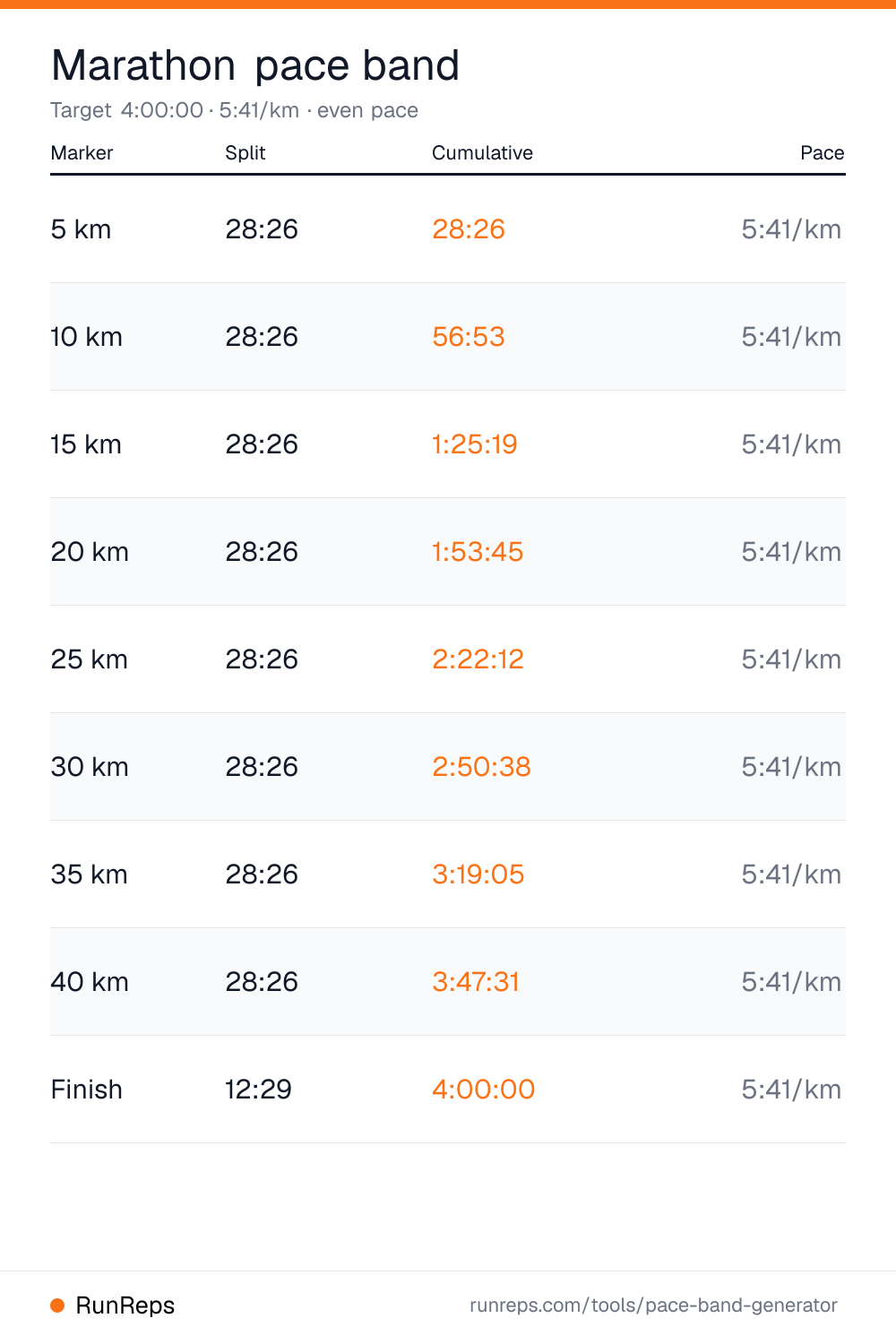
A 4:00:00 marathon is 5:41 per kilometre, held for 42.195 km. On even pacing every 5 km split takes 28:26, so the band reads 28:26 at 5 km, 56:53 at 10 km, 1:53:45 at 20 km and 3:47:31 at 40 km, with the final 2.195 km taking 12:29. The table below is exactly what the generator prints for that target.
Reading it mid-race is a single check: is the time on your watch at this marker earlier or later than the time on the band? Ten seconds either way is noise. A minute early at 10 km is not a gift to keep, it is a warning that you are running the first quarter faster than the pace you trained for, and the marathon collects that debt after 30 km with interest.
If you are still deciding what target to write on the band, the honest source is a recent race rather than a round number. The race time predictor converts a 10K or half marathon result into an equivalent marathon time, and predicting a marathon finish without guessing explains why the shorter race is the more reliable evidence.
| Marker | Split | Cumulative | Pace |
|---|---|---|---|
| 5 km | 28:26 | 28:26 | 5:41/km |
| 10 km | 28:26 | 56:53 | 5:41/km |
| 15 km | 28:26 | 1:25:19 | 5:41/km |
| 20 km | 28:26 | 1:53:45 | 5:41/km |
| 25 km | 28:26 | 2:22:12 | 5:41/km |
| 30 km | 28:26 | 2:50:38 | 5:41/km |
| 35 km | 28:26 | 3:19:05 | 5:41/km |
| 40 km | 28:26 | 3:47:31 | 5:41/km |
| Finish | 12:29 | 4:00:00 | 5:41/km |
A half marathon band, even pace against a 3% negative split
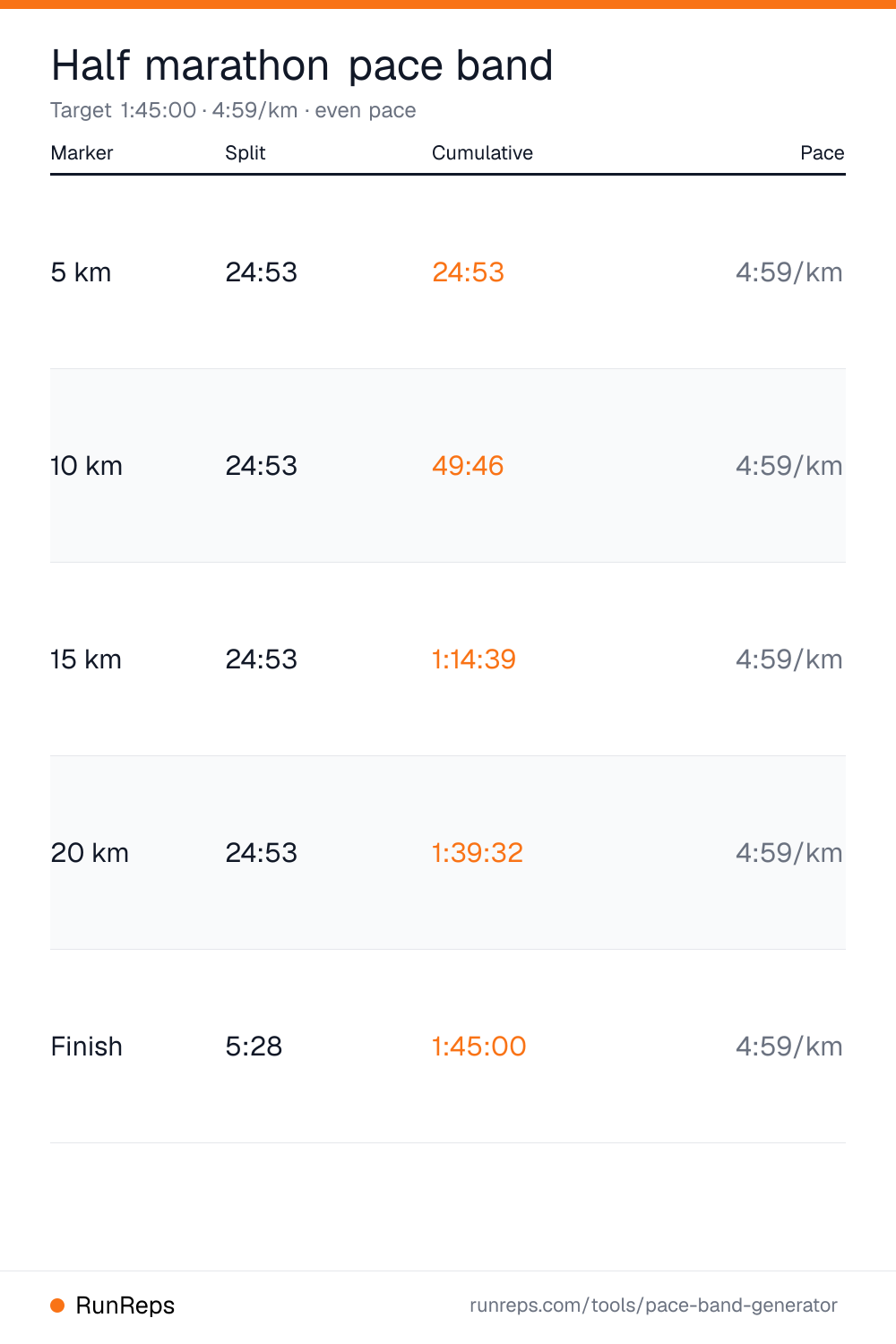
A 1:45:00 half marathon is 4:59 per kilometre. Even pacing gives 5 km splits of 24:53, so you pass 10 km at 49:46 and 20 km at 1:39:32 before the last 1.0975 km closes it out in 5:28. That is the band most runners should start with, because even pacing is the easiest thing to execute and the hardest thing to get badly wrong.
Set the same target to a 3% negative split and the generator redistributes the effort. The first 5 km slows to 25:10 at 5:02 per kilometre, 10 km arrives at 50:10, and each later split gets faster until the finish is being run at 4:54 per kilometre. The total is still 1:45:00; only the shape has changed. The percentage on the slider is the gap between the two halves, so 3% means the second half runs roughly 3% faster than the first.
Which to choose depends on the course and on you. A negative split suits a flat course and a runner who has rehearsed holding back. The negative split calculator builds the two halves in more detail, and the strategy behind every sub-3 marathon covers why the pattern keeps turning up in strong finishes. If the second half of your course climbs, an even band is usually the more honest one to wear.
| Marker | Split | Cumulative | Pace |
|---|---|---|---|
| 5 km | 25:10 | 25:10 | 5:02/km |
| 10 km | 25:00 | 50:10 | 5:00/km |
| 15 km | 24:49 | 1:14:59 | 4:58/km |
| 20 km | 24:38 | 1:39:37 | 4:56/km |
| Finish | 5:23 | 1:45:00 | 4:54/km |
Getting the target pace right before you print anything
A pace band is only as good as the number you put into it, and the number most people put into it is a wish. If the target came from a recent race at a nearby distance, wear the band with confidence. If it came from a training plan's headline goal or from what a friend ran, treat it as a hypothesis and print a second, slower band for the day the first one stops making sense at 25 km.
The pace calculator turns a finish time into the pace it needs, in minutes per kilometre and per mile, and the split time calculator produces the same split and cumulative times as the band for any split distance you choose, if your course marks miles or odd intervals. Together they cover the two questions this page assumes you have already answered: what pace, and at which markers.
Frequently asked questions
What is a marathon pace band?
A pace band is a strip of paper worn on the wrist that lists the time you should see at each marker if you are on target. For a marathon this generator prints a row every 5 km plus the finish, so at each marker you compare the clock with the band instead of doing arithmetic at 30 km.
Should I use even splits or negative splits?
For most runners, even splits or a very slight negative split (1–2% faster in the second half) produces the best results. Going out too fast burns glycogen early and leads to a significant slowdown in the final miles.
How do I use a pace band in a race?
Write the target split times on your wrist with a marker, or screenshot the pace band on your phone. At each split marker, compare your actual time to the target. If you are ahead early, slow down - banking time in the first half rarely works.